Restricted Volume
Necronomicon
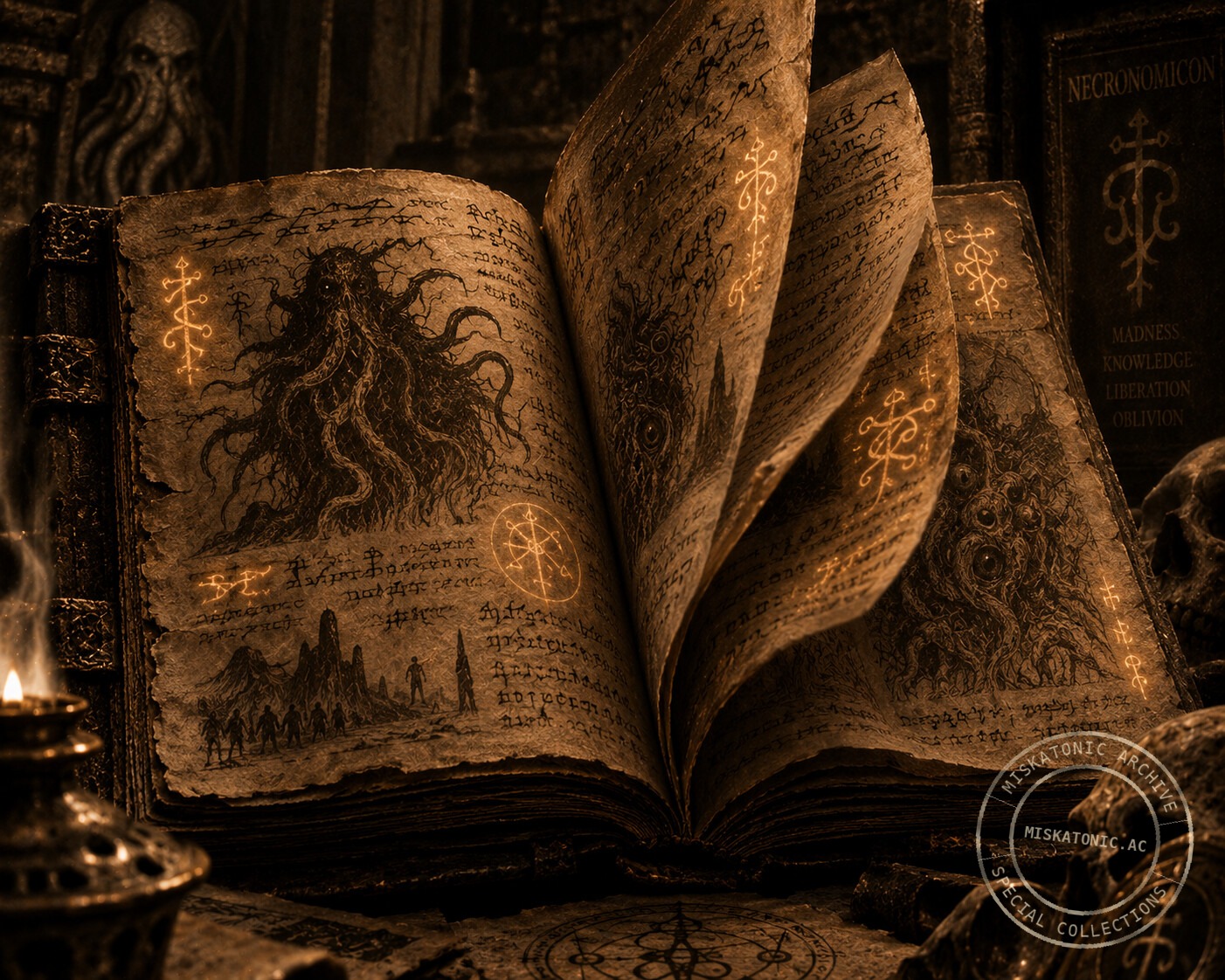
The Archive holds one confirmed volume of the Necronomicon — a 15th-century Latin printing, kept under the same restriction as the rest of Special Collections — and treats the wider history of the text as established fact rather than legend, on the strength of correspondence, acquisition records, and the testimony bound into several of the chronicles catalogued elsewhere in this Archive.
The original was composed as the Al Azif, an Arabic title referring to the night-sound of insects that was long believed, in the region, to be the voice of demons. Its author, Abdul Alhazred, is recorded as a poet of Sanáa who spent his final years wandering the ruins of Babylon and Memphis and the ‘nameless city’ beneath the southern deserts, before settling in Damascus to compile what he had found. He did not survive to see the book's influence — see Known Readers below.
The text passed from Arabic into Greek (Theodorus Philetas, Constantinople, 950 AD, under the title by which it is known here) and from Greek into Latin (Olaus Wormius, 1228), acquiring the name Necronomicon somewhere in that first translation. Both the Greek and Latin editions were formally banned by Pope Gregory IX in 1232, which did more to drive the book underground than to remove it from circulation. A black-letter Latin printing followed in Germany in the 15th century, and a Greek printing in Italy in the 17th — by which point the original Arabic text had already been lost.
No two accounts of its contents agree in full, which the Archive takes as read: the book is reportedly resistant to being summarized honestly by anyone who has spent long enough with it to try.
Known Readers
- Abdul Alhazred — Author, ca. 730 AD — died
- Theodorus Philetas — Greek translator, Constantinople, 950 AD — survived
- Olaus Wormius — Latin translator, 1228 — survived
- Dr. John Dee — Elizabethan scholar; attempted English translation — survived
- Wilbur Whateley — Repeated reader, Miskatonic copy (The Dunwich Horror) — died
- Henry Armitage — Miskatonic head librarian (The Dunwich Horror) — survived
- Joseph Curwen — Owner, 18th-century private copy (The Case of Charles Dexter Ward) — died
- Charles Dexter Ward — Researcher; inherited Curwen's library (The Case of Charles Dexter Ward) — insane
- St. John and an unnamed companion — Grave-robbers; recognized the book's characters on a stolen amulet (The Hound) — died
- Unnamed narrator — Reader of a single passage, Kingsport gathering (The Festival) — survived
- Nathaniel Peaslee — Researcher, consulted during his own missing years (The Shadow Out of Time) — survived